
The diversified geography of Nepal creates huge variations in the country's climatic zones; however, the building industry has so far used standardized methods that tend to neglect local climate conditions. Most of these standards then rely on energy-intensive mechanical systems to maintain indoor thermal comfort, without considering more viable and climate-responsive design methods. In this light, the development of a climate classification related to building design will help develop and encourage energy- and climate-effective building architecture in Nepal. The existing energy-saving practice in the building sector of the country is reviewed in this paper, and it outlines ways to improve the adaptation of energy-efficient methodology. It shows that passive houses are performing much better in comparison with modern constructions that are behind in terms of energy efficiency when compared with traditional homes. The study outlines the climate-specific design criteria and methodologies for various regions and sets the path for exploration of the passive house design process challenges and opportunities that might exist for wider diffusion. Also discussed are strategies to overcome the barriers and promote passive house construction, offering a pathway toward sustainable building practices in Nepal.
| Published in | International Journal of Sustainable and Green Energy (Volume 13, Issue 3) |
| DOI | 10.11648/j.ijrse.20241303.12 |
| Page(s) | 58-66 |
| Creative Commons |
This is an Open Access article, distributed under the terms of the Creative Commons Attribution 4.0 International License (http://creativecommons.org/licenses/by/4.0/), which permits unrestricted use, distribution and reproduction in any medium or format, provided the original work is properly cited. |
| Copyright |
Copyright © The Author(s), 2024. Published by Science Publishing Group |
Buildings, Diverse Geography, Climate, Passive
Climatic Zones | Altitude (meters) | Mean Temperature (Celsius) | |
|---|---|---|---|
Sub-tropical | 0-1200 | 15 | >30 |
Warm temperate | 1200-2100 | 10 | 24-30 |
Cold temperate | 2100-3300 | <5 | 20 |
Alpine | 3300-5000 | <0 | Loka.15 |
Tundra | Above 5000 | <0 | <0 |
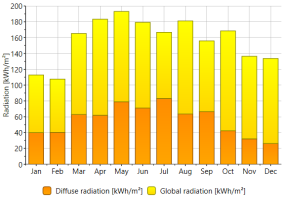
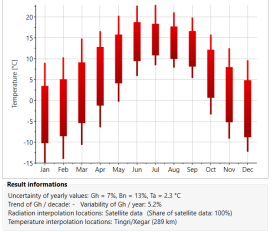
Month | Gh (kWh/m²) | Dh (kWh/m²) | Bn (kWh/m²) | Ta (°C) | Td (°C) | FF (m/s) |
|---|---|---|---|---|---|---|
January | 113 | 40 | 147 | -3.9 | -5.7 | 1.2 |
February | 108 | 40 | 122 | -2 | -3.8 | 1.7 |
March | 165 | 63 | 165 | 1.5 | -0.3 | 1.9 |
April | 183 | 62 | 184 | 5.7 | 3.9 | 2.0 |
May | 193 | 79 | 162 | 9.9 | 8.1 | 1.9 |
June | 179 | 71 | 151 | 14.3 | 12.3 | 1.7 |
July | 167 | 83 | 121 | 14.6 | 12.6 | 1.4 |
August | 181 | 64 | 172 | 13.8 | 11.7 | 1.4 |
September | 156 | 67 | 142 | 12.4 | 10.3 | 1.4 |
October | 168 | 42 | 214 | 6.2 | 4.5 | 1.4 |
November | 136 | 32 | 210 | 1 | -0.7 | 1.2 |
December | 134 | 26 | 235 | -2.5 | -4.1 | 1.1 |
Year | 1880 | 669 | 2026 | 5.9 | 4.1 | 1.5 |
Building Material | Density (kg/m3) | Specific heat capacity (J/kg.K) |
|---|---|---|
Water | 1000 | 4190 |
Air | 1.0035 | 1204 |
Brick | 888 | 840 |
Concrete | 2240 | 2240 |
Stone, Granite | 2640 | 820 |
Stone, Marble | 2600 | 800 |
Basis | Hot humid summer, warm winter | Warm humid summer, mild winter | Hot dry summer, warm winter | Hot dry summer, cool winter |
|---|---|---|---|---|
Windows and shading | 1) All windows and walls, even those that face south, should be shaded. If possible, provide extended eaves; if not, use vertical shading. 2) To prevent heat gain or cooling loss, use window frames with thermal breaks and glazing with a low solar heat gain coefficient (SHGC) 3) Planting and shade structures can provide shade for the house, especially for the windows and outdoor areas. | 1) Use glazing sparingly. 2) In regions with cooler winters or hotter summers, use low SHGC glazing in all situations, and low U value glazing with thermally fractured frames in other regions. 3) Utilize windows that can be fully opened, such as louver or casement windows, and cover | 1) Use low U- value glazing and try to avoid overusing it. 2) In areas with warm summers and moderate winters, use low SHGC glazing; in areas with chillier winters, use double glazing. 3) In the summer, shade all windows with an east or west exposure, and in structures located north of the tropic of Capricorn, shade windows with a south exposure. | 1) Use double glazing sparingly and think about using it in bedrooms and living spaces to reduce the need for glazing. 2) Utilize frameworks that are insulated or thermally enhanced. 3) Add passive solar shade to north- facing windows, and in the summer, cover all east- and |
Insulation | 1) Keep walls and ceilings free of bulk insulation, unless they are in climate-controlled areas. 2) Internal wall surfaces should be well-insulated from any external thermal mass. 3) To prevent condensation and upward heat movement, insulate elevated floors using reflective, closed- cell bulk insulation. | 1) Use several layers of the reflective foil to produce a 1-way valve effect in roof and ceiling spaces in places where no winter heating is needed. 2) Discourage any external thermal mass by insulating interior wall surfaces. 3) Walls should be lined with highly permeable reflective vapor barriers, and air-conditioned rooms should also have bulk insulation added. | 1) Utilize bulk or reflective insulation in the walls and ceilings. 2) All thermal mass should have exterior insulation. 3) When using in- slab heating and higher floors, insulating concrete slabs should be done | 1) All thermal 2) mass should have exterior insulation. 3) When using in-slab heating and higher floors, insulating concrete slabs should be done. 4) Verify that every compartment is airtight. |
Construction systems | 1) Utilize lightweight (low-mass) building materials. 2) Use materials for the external walls and roof that are light-colored and reflective. | 1) When day-night temperature differences are small, use lightweight wall construction; when they are greater than 6°C, add thermal bulk. 2) Use elevated lightweight floors where the ground temperature in the summertime is more than 19°C at a depth of 3meters. | 1) Build with high thermal mass. 2) Use insulated concrete slabs or elevated lightweight floors with high thermal mass walls in areas where summer ground temperatures are above 19°C at a depth of 3 meters. | 1) Take high thermal mass building as an example. 2) Use slabs with earth coupling. 3) Select roofing materials in bright colors. |
Warm temperate | Mild temperate | Cool temperate | Alpine | |
|---|---|---|---|---|
Windows and shading | 1) Do not overdo glazing. 2) For windows that face orth, use passive solar shading, and during the summer, cover any windows that face east and west. 3) To permit varying solar access in the spring and fall, take into account changeable shade. | 1) Use high SHGC and low U- value glazing instead of overusing. 2) Use tight-fitting drapes with pelmets or insulating blinds. 3) Reduce and cover all east and west- facing windows during the summer. | 1) Don't utilize glazing excessively, and carefully size and align windows. 2) Utilize double glazing with a high SHGC, low U value, and thermally enhanced or insulated frames. 3) Include passive solarshade for windows with a north orientation. | 1) Use thermally improved or insulated frames, double glazing with a high SHGC, and windows with a low U value. 2) Use thick drapes with sealed pelmets or insulating blinds. A couple more options to think about are double curtains or insulating blinds. 3) East-facing windows should be avoided since morning fog reduces winter solar benefits. |
Insulation | 1) Use bulk or reflective insulation in the walls and ceilings, respectively. 2) When using in- slab heating and higher floors, insulating concrete slabs should be done 3) All thermal mass should have exterior insulation. | 1) If employing under-slab heating, insulate concrete slabs. 2) To estimate the proper insulation levels in high thermal mass walls like rammed earth or mud brick, calculate the thermal lag. 3) Include entry airlocks and completely seal the area to prevent drafts. | 1) All walls, ceilings, and exposed floors should be bulk-insulated. 2) For walls, utilize bulk insulation with highly permeable sarking or several layers of reflective foil insulation, with careful planning to lower the risk of condensation. 3) If employing under-slab heating, insulate concrete slabs and add airlocks to entrances. | 1) All walls, ceilings, and exposed floors should be thickly insulated. 2) To attain a higher rating for the wall insulation, think about utilizing 150mm or 200mm deep studs. 3) Use the highest degrees of bulk insulation in the ceilings and externally insulate to high levels of any thermal mass, especially rammed earth and mud brick. |
Construction systems | 1) Take earth-coupled slabs and composite thermal mass construction into consideration. 2) Choose finishing, roofs, and walls with low embodied energy. | 1) Take thermal mass composite construction as an example. 2) Glass-to-mass ratios that are appropriate can be used with high thermal mass walls. | 1) Unless the earth's temperature is below 16°C at a depth of 3 meters in the winter, use earth-coupled slabs. 2) Increase thermal mass and solar exposed glass as diurnal temperature variations rise above 6°C, and use lightweight wall construction where they are low. | 1) Use highly insulated, lightweight flooring or insulate the ground beneath slabs. 2) In areas that do not receive direct sunshine, use well-insulated, low-thermal mass walls. |
| [1] | C. Diakaki, E. Grigoroudis, and D. Kolokotsa, “Towards a multi-objective optimization approach for improving energy efficiency in buildings,” Energy Build., vol. 40, no. 9, pp. 1747–1754, 2008, |
| [2] | T. Bajracharya, S. R. Shakya, and S. Bajracharya, “Energy Efficient Building in Kathmandu Valley – A Case Study of Passive and Contemporary Residential Building Sample Size Calculation Energy Efficiency Measures Case Study Investigated Contemporary Residential,” Proc. IOE Grad. Conf., no. August, pp. 599–608, 2020. |
| [3] | Water and Energy Commission Secretariat (WECS), “Energy Synopsis Report 2023,” p. 131, 2023. |
| [4] |
“Household | National Population and Housing Census 2021 Results.”
https://censusnepal.cbs.gov.np/results/household (accessed Mar. 19, 2024). |
| [5] | S. Tha and S. Uprety, “Energy Efficiency in Traditional Newari Residential Buildings : A Case of Bhaktapur (Itachhen Tole),” vol. 8914, pp. 452–459, 2020. |
| [6] | S. Bodach, W. Lang, and J. Hamhaber, “Climate responsive building design strategies of vernacular architecture in Nepal,” Energy Build., vol. 81, pp. 227–242, 2014, |
| [7] |
J. Kandel, “An Approach Towards Energy Efficient Buildings for Sub-tropical Climate of Nepal,” no. March, 2019, [Online]. Available:
https://www.theseus.fi/bitstream/handle/10024/161412/thesis final- JYOTI KANDEL.pdf?sequence=2 |
| [8] |
“What is a Passive House? [Passipedia EN].”
https://passipedia.org/basics/what_is_a_passive_house (accessed Mar. 26, 2024). |
| [9] |
“A Very Modern Way to Achieve Energy Savings: The Unrivaled Benefits of a ‘Passive House’ - Energy Professionals | Leading Energy Advisers.”
https://www.energyprofessionals.com/a-very-modern-way-to-achieve-energy-savings-the-unrivaled-benefits-of-a-passive-house/ (accessed Mar. 28, 2024). |
| [10] | S. Bodach, “Developing bioclimatic zones and passive solar design strategies for Nepal,” 30th Int. PLEA Conf. Sustain. Habitat Dev. Soc. Choos. W. Forw. - Proc., vol. 1, no. December 2014, pp. 167–174, 2014. |
| [11] |
Syarifah, "Covariance Structural Analysis on Health-Related Indicators in Home-Based Elderly with a Focus on Subjective Health Perception," Africa Education Review, vol. 15, no. 1, pp. 156–179, 2010. [Online]. Available:
http://joi.jlc.jst.go.jp/JST.Journalarchive/materia1994/46.171?from=CrossRef |
| [12] |
C. D. A. Porteous, “Profiting From Sunshine: Passive Solar Building in the Mountains,” Mt. Res. Dev., vol. 21, no. 1, pp. 96–97, 2001,
https://doi.org/10.1659/0276-4741(2001)021[0096:pfspsb]2.0.co;2 |
| [13] | M. Hu, K. Zhang, Q. Nguyen, and T. Tasdizen, “The effects of passive design on indoor thermal comfort and energy savings for residential buildings in hot climates: A systematic review,” Urban Clim., vol. 49, p. 101466, May 2023, |
| [14] |
“What is Passive House? - The Passive House Network.”
https://passivehousenetwork.org/regional/what-is-passive-house/ (accessed Mar. 27, 2024). |
| [15] |
“Passivhaus Institut.”
https://passiv.de/en/02_informations/02_passive-house-requirements/02_passive-house-requirements.htm (accessed Mar. 27, 2024) |
| [16] |
“K-Value, U-Value, R-Value: How To Measure Thermal Insulation.”
https://globepanels.com/k-value-u-value-r-value-how-do-we-measure-thermal-insulation/ (accessed Mar. 27, 2024) |
| [17] | Florian Lang, D. “Certification Documentation.” Journal Name, vol. 17, no. 4, 2024, pp. 18505–18514. |
| [18] |
“Design for climate | YourHome.”
https://www.yourhome.gov.au/passive-design/design-climate (accessed Mar. 27, 2024). |
| [19] | A. Albatayneh, D. Alterman, A. Page, and B. Moghtaderi, “The Significance of Building Design for the Climate,” Environ. Clim. Technol., vol. 22, no. 1, pp. 165–178, Dec. 2018, |
| [20] | C. Parry, “Passivhaus in Australia,” 2014. |
| [21] | Sjölund, S. "Sustainable Building in Australia and Sweden: A Comparative Study of Passive Design Techniques and Life Cycle Costs." MSc Programmes in Engineering, Civil and Mining Engineering, Department of Civil and Environmental Engineering, Division of Architecture and Infrastructure, 2014. |
| [22] |
“What Is a Passive House? Principles and Design.”
https://www.treehugger.com/what-is-a-passive-house-principles-and-design-5443122 (accessed Mar. 27, 2024). |
| [23] |
“Passive houses are sustainable – but are they affordable? | World Economic Forum.”
https://www.weforum.org/agenda/2021/01/passive-housing-sustainable-emissions-reduction/ (accessed Mar. 27, 2024). |
| [24] | J. Carlander and P. Thollander, “Barriers to implementation of energy-efficient technologies in building construction projects — Results from a Swedish case study,” Resour. Environ. Sustain., vol. 11, no. July 2022, p. 100097, 2023, |
| [25] | J. Palm and E. Bryngelson, “Energy efficiency at building sites: barriers and drivers,” Energy Effic., vol. 16, no. 2, 2023, |
| [26] | P. Gupta, S. Anand, and H. Gupta, “Developing a roadmap to overcome barriers to energy efficiency in buildings using best-worst method,” Sustain. Cities Soc., vol. 31, pp. 244–259, 2017, |
APA Style
Bhandari, S., Shrestha, S. L., Baral, B. (2024). Passive House Design: A Possible Energy Efficient Option in the Building Sector of Nepal. International Journal of Sustainable and Green Energy, 13(3), 58-66. https://doi.org/10.11648/j.ijrse.20241303.12
ACS Style
Bhandari, S.; Shrestha, S. L.; Baral, B. Passive House Design: A Possible Energy Efficient Option in the Building Sector of Nepal. Int. J. Sustain. Green Energy 2024, 13(3), 58-66. doi: 10.11648/j.ijrse.20241303.12
AMA Style
Bhandari S, Shrestha SL, Baral B. Passive House Design: A Possible Energy Efficient Option in the Building Sector of Nepal. Int J Sustain Green Energy. 2024;13(3):58-66. doi: 10.11648/j.ijrse.20241303.12
@article{10.11648/j.ijrse.20241303.12,
  author = {Sangam Bhandari and Shubha Laxmi Shrestha and Bivek Baral},
  title = {Passive House Design: A Possible Energy Efficient Option in the Building Sector of Nepal
},
  journal = {International Journal of Sustainable and Green Energy},
  volume = {13},
  number = {3},
  pages = {58-66},
  doi = {10.11648/j.ijrse.20241303.12},
  url = {https://doi.org/10.11648/j.ijrse.20241303.12},
  eprint = {https://article.sciencepublishinggroup.com/pdf/10.11648.j.ijrse.20241303.12},
  abstract = {The diversified geography of Nepal creates huge variations in the country's climatic zones; however, the building industry has so far used standardized methods that tend to neglect local climate conditions. Most of these standards then rely on energy-intensive mechanical systems to maintain indoor thermal comfort, without considering more viable and climate-responsive design methods. In this light, the development of a climate classification related to building design will help develop and encourage energy- and climate-effective building architecture in Nepal. The existing energy-saving practice in the building sector of the country is reviewed in this paper, and it outlines ways to improve the adaptation of energy-efficient methodology. It shows that passive houses are performing much better in comparison with modern constructions that are behind in terms of energy efficiency when compared with traditional homes. The study outlines the climate-specific design criteria and methodologies for various regions and sets the path for exploration of the passive house design process challenges and opportunities that might exist for wider diffusion. Also discussed are strategies to overcome the barriers and promote passive house construction, offering a pathway toward sustainable building practices in Nepal.},
 year = {2024}
}
TY  - JOUR
T1  - Passive House Design: A Possible Energy Efficient Option in the Building Sector of Nepal

AU  - Sangam Bhandari
AU  - Shubha Laxmi Shrestha
AU  - Bivek Baral
Y1  - 2024/10/29
PY  - 2024
N1  - https://doi.org/10.11648/j.ijrse.20241303.12
DO  - 10.11648/j.ijrse.20241303.12
T2  - International Journal of Sustainable and Green Energy
JF  - International Journal of Sustainable and Green Energy
JO  - International Journal of Sustainable and Green Energy
SP  - 58
EP  - 66
PB  - Science Publishing Group
SN  - 2575-1549
UR  - https://doi.org/10.11648/j.ijrse.20241303.12
AB  - The diversified geography of Nepal creates huge variations in the country's climatic zones; however, the building industry has so far used standardized methods that tend to neglect local climate conditions. Most of these standards then rely on energy-intensive mechanical systems to maintain indoor thermal comfort, without considering more viable and climate-responsive design methods. In this light, the development of a climate classification related to building design will help develop and encourage energy- and climate-effective building architecture in Nepal. The existing energy-saving practice in the building sector of the country is reviewed in this paper, and it outlines ways to improve the adaptation of energy-efficient methodology. It shows that passive houses are performing much better in comparison with modern constructions that are behind in terms of energy efficiency when compared with traditional homes. The study outlines the climate-specific design criteria and methodologies for various regions and sets the path for exploration of the passive house design process challenges and opportunities that might exist for wider diffusion. Also discussed are strategies to overcome the barriers and promote passive house construction, offering a pathway toward sustainable building practices in Nepal.
VL  - 13
IS  - 3
ER  -
Mechanical Engineering, School of Engineering, Kathmandu University, Dhulikhel, Nepal

Information


 Share This Article
 Twitter
 Linked In
 Facebook
 Copy
Copy Download